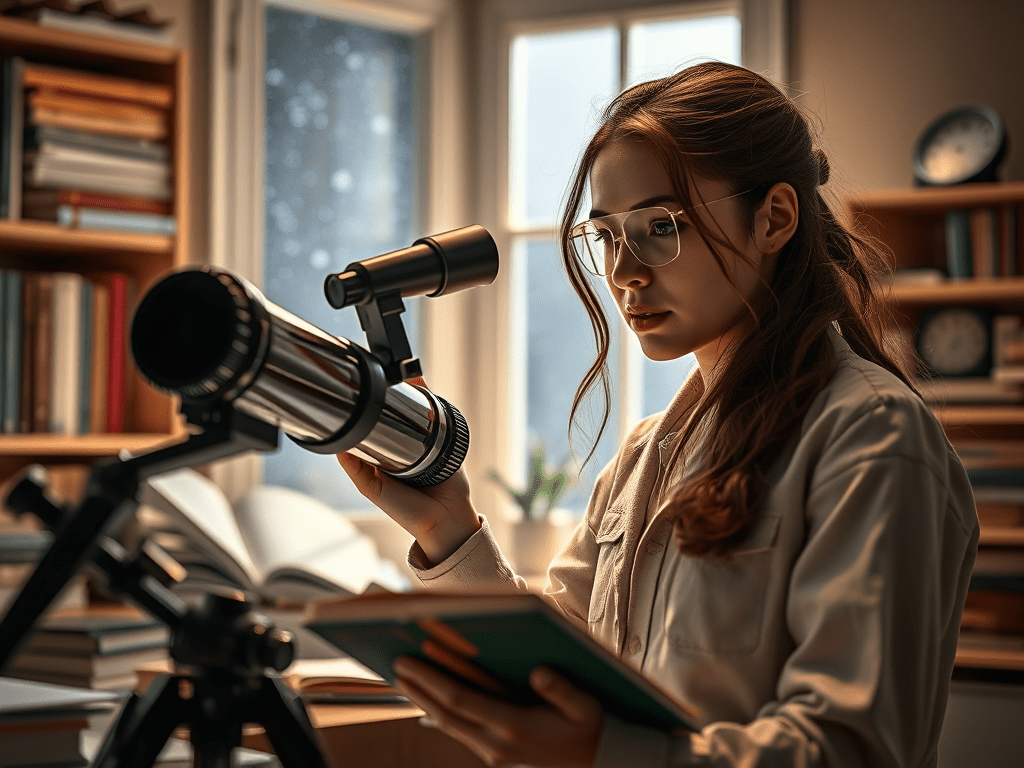
Everything that we experience on this planet can be related to science. Science can be used as a tool to break away from an environment that only teaches us the “what”, allowing us to explore the “why”. As a child, I was always asking “why?”. I was never satisfied with a simple explanation of what was happening around me, I needed to know why it was happening; endless questioning on what makes the world spin. When I began my schooling, I was immediately immersed in learning about science. Like many children in Perth, I was fascinated by SciTech, an educational institution aimed at children, exploring topics including physics, chemistry, biology and astronomy. This is where my fascination with the night sky began, visiting the planetarium and learning about the universe that we call home. This interest never really dissipated, with astrophotography becoming an important hobby of mine years later.
Role models in education are vital in the immersion of learning. My interest in science was always encouraged by my parents, my Dad is an engineer and loved all things physics, and my Mum was a teacher with a background in various sciences. Neither of my parents discouraged me asking “why?”, always jumping at the opportunity to answer my questions. Additionally, my stepmother being a high school chemistry teacher encouraged me to pursue that subject area as an ATAR subject, along with Physics and Human Biology. My experience as a Chemistry student was further enriched by my teacher, a strong woman who had dedicated her life to learning and teaching science. After graduating, I elected to study psychology at university. Psychology always made a lot of sense to me, as a neurodivergent person I have spent my entire life analysing the behaviours of others, and wondering why brains work so differently to one another. Combined with my studies of Gender Studies as my second major, I have found that the more I learn, I find more things that I need to learn, but I don’t think I will ever stop asking questions.
As a woman studying science, my experience in education was inevitably going to be different to my male counterparts. Furthermore, my final years of high school were spent in a recently converted co-educational environment, meaning that my peer group was largely dominated by men. In this environment, males tend to dominate class discussions and discuss examples related to the content that is more “contextually relevant” to their own experiences, which leads to the absorption of teacher attention (Hazari et al. 2013). My intelligence concerning the sciences was often openly underestimated due to my gender, with male classmates dismissing my thoughts and contributions to class discussions. These attitudes effected my willingness to participate in classroom discussions, despite having valid contributions that would further develop classroom discourse. This is not an uncommon experience for women studying science, with impression management playing a large role in male achievements. While most believe that opportunities are given based on academic merit, often one’s self-talk and boasting ability can play a large role, especially when in regards to male achievement (Kumra 2024). In my own educational environment, this manifested itself when male students were selected for competitions, public speaking and leadership, opportunities that were not based on academic prowess, rather their ability to “talk the talk”.
In addition to gendered differences, science works to find the world’s truth; and where there is a search for truth, there must be absolutes. These absolutes often rest within the sex/gender binary, whether that lies within experimental control or sample demographics. Fausto-Sterling (2019) explores how in the fields of psychology and biology, heterosexuality is deemed as “normal”, and non-heterosexuality is often categorised as a data point that is an outlier. The author also touch on how insufficient research has been done in science defining the “grey area” of gender and sexuality, drawing attention to the fact that non-heterosexuality is measured rather than the presence of homosexuality, which implies a deficit or problem, which could be perceived as a problematic standpoint (Fausto-Sterling 2019).
Furthermore, when discussing gender binaries, gender non-conformity is often a factor that is frequently overlooked. While sex education in schools is improving, just expanding the distance from “abstinence-only” education is not sufficient. Simply teaching sexual biology from a binary perspective has indicated socialisation problems between trans and gender non-conforming individuals with their peers due to lack of awareness and understanding. This ultimately leads to higher rates of mental health problems within these groups, not due to their feelings of self, but rather based on familial and societal reactions to such identities (Boskey 2014). Nuanced science education that encourages acceptance and tolerance would drastically improve the mental health outcomes for gender nonconforming youth (Stieglitz 2010). Despite the aforementioned, as an AFAB person who is perceived as a woman, I do not experience the same discrimination as AMAB individuals. This is because our society unequivocally favours masculinity over femininity, a concept supported by essentialism through the reinforcement that certain groups have inherent similarities which allows for prejudice and discrimination (Rhodes and Moty 2020). Society “allows” AFAB individuals to engage in masculine behaviours, sometimes even encouraging masculine clothing and activities, hence my thorough engagement with the sciences from a young age. However, AMAB individuals are actively discouraged from exploring their femininity, with feminine clothing choices and behaviours often posing a threat to their safety. This is because masculinity is hegemonic within our society, male roles are deemed as “aspirational” while female roles are associated with subordination and weakness, a belief that has continued to devalue femininity and women throughout history (Boskey 2014). Concerning science participation, this theory explains why most famous scientists used in modern-day education are male, reflected in YouTube channel engagement, a tool often used in schools that creates education role models for people at a young age (AsapSCIENCE 2020).
When critically analysing access to education, whether science-based or not, barriers formed by social class must be considered. I do not pretend to understand this disadvantage intrinsically, as I was lucky to have grown up with class privilege, an advantage that I received solely based on luck due to the family that I was born into. I was not deprived of any opportunities based on my situation or financial standing, and I recognise that this is a privilege I received that has nothing to do with my merit or skill. I have always been a person who cares very deeply about others, and I strive to use this to learn about the world around me while ensuring that my voice does not speak over those with that lived experience. The class system in Australia revolves heavily around private education, meaning that the school an individual attends defines where they stand in Australian society, with little to no movement available. Private schools, specifically those requiring extensive fees and fostering elitism, provide students with an education that goes beyond traditional learning; students are provided with elitist social etiquette, humour patterns and connections that cannot be achieved outside of a small social bubble. This maintains generational privilege and allows social discrimination to continue (State School Teachers’ Union of WA 2017).
In addition to fostering an unattainable upper class, the funding that private schools receive from the government is appalling considering the extensive fees that are already paid for attendance. Education in Australia is viewed as a commodity when it should be a human right. Funding to public schools, specifically those in already disadvantaged areas, has been partially rescinded by The Commonwealth, while private school funding has been maintained (Black 2021). Actions like this work in favour of increasing the class divide, depriving children of quality education and opportunities merely based on biased funding allocations (Black 2021). My love of science began at a young age while being privately educated, many of the experiences I had that fostered that love were fuelled by my school’s access to resources and funding for experiences. In this way, the class system allowed me to participate in science in ways that most children did not get the rightful opportunity to. In addition to early education, access to higher education is limited by the class system. The benefits of attending university are sung by the leaders of Australia, while simultaneously increasing the costs and requirements of admittance. Public discourse fails to recognise the embodiment of the class disadvantage, referring to this as belonging to someone’s background, implying that this background no longer exists when in higher education and getting a “fair go” (Bunn, Threadgold, and Burke 2019). Getting a higher education often means students will have to reduce their working hours, travel longer distances and work lower-paying jobs while they work towards their qualifications. For those without a financial safety net to fall back on, this reality can make higher education unattainable (Black 2021). Science can often only be pursued as part of a career through higher education, therefore highlighting the class barrier to science participation.
My engagement with the sciences has been an enriching experience, allowing me to learn about the world around me and providing me with explanations for the questions that encompassed my young mind. While my experience participating in science has been challenging at times, I am grateful for the opportunities I did receive that have allowed me to pursue my career in psychology. Acknowledgement of the effects that gender, sexuality, and class have on science participation is the first step in creating a more egalitarian experience of education within the sciences. I hope that one day I can foster a love in the sciences for those around me, and create a world where science is for everyone.


 Libby's Odyssey
Leave a comment